
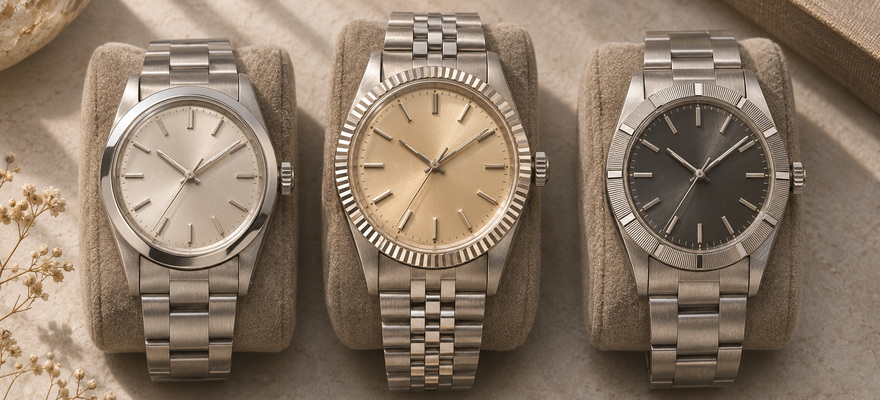
Put two Rolex Datejust replica watches side by side, and the bezel can shape your first impression before you notice the dial. A smooth ring keeps the watch quiet. Fluting sends little flashes of light across the wrist. On a GMT-Master II, a strip of blue, red, or green can become the detail everyone remembers.
That ring also deserves a closer look for less obvious reasons. It may measure elapsed time, help you read another time zone, or control what the winding crown adjusts. On an older watch, it can raise questions about service history and originality. Understanding replica Rolex bezels makes it easier to choose a watch you’ll enjoy wearing—and to ask better questions before buying one.
Start With the Bezel, Then Look at the Insert
The bezel is the ring around the watch crystal. An insert is a separate component fitted into a bezel assembly, often carrying the numbers or timing scale. On a modern Rolex GMT-Master II replica, the colored ceramic ring is an insert; on a Datejust, the white-gold fluting is the bezel itself.
This distinction matters when a seller describes damage or a service center prepares an estimate. A chipped insert, a bent outer ring, and a problem with the rotating mechanism are different repairs. “Needs a bezel” doesn’t tell you enough.
It also helps to separate appearance from operation. Fluted describes a surface. Fixed or rotating describes how the part works. Those categories overlap: a Datejust’s fluted bezel stays put, while the fluted bezel on a Sky-Dweller turns to select a setting function.
A Quick Guide to Rolex Bezel Styles
No single tidy list covers every variation Rolex has made. These are the main designs you’re likely to encounter, with examples rather than an exhaustive model catalog.
| Design | What to notice | Familiar examples |
|---|---|---|
| Smooth or domed | An undecorated, fixed ring; its curvature and width change the look | Oyster Perpetual, Explorer, and selected Datejust models |
| Fluted | Repeated polished facets; usually fixed, with the Sky-Dweller as an important exception | Datejust, Day-Date, Sky-Dweller |
| Engine-turned | Fine decorative cuts, often interrupted by polished sections | Older Datejust and Air-King references |
| Rotating 60-minute dive bezel | Elapsed-time scale; current versions turn counterclockwise only | Submariner, Sea-Dweller, Deepsea |
| Rotating 24-hour bezel | A scale read with the 24-hour hand; turns in both directions | GMT-Master and GMT-Master II |
| Fixed 24-hour bezel | A stationary scale for the additional 24-hour hand | Explorer II |
| Bidirectional 60-minute bezel | Elapsed-time timing with adjustment in either direction | Yacht-Master; the redesigned 2026 Yacht-Master II |
| Tachymeter | A fixed scale used with the chronograph to calculate average speed | Cosmograph Daytona |
| Ring Command | A rotating control linked to the movement’s setting mechanism | Sky-Dweller; the previous-generation Yacht-Master II |
| Gem-set | Diamonds or colored stones; factory origin and condition need separate checks | Selected Datejust, Day-Date, Daytona, and Yacht-Master models |
Choosing the Look: Smooth, Fluted, or Engine-Turned?
Smooth and domed bezels give the dial more room
A plain polished bezel leaves the dial and bracelet to do most of the visual work. It’s an easy choice if you like a Datejust but prefer less sparkle, or if you want a colorful dial to stand out.
“Smooth” and “domed” aren’t always interchangeable in Rolex’s specifications. Smooth describes the undecorated surface; domed refers to the rounded profile. For example, Rolex lists the Datejust 36 reference 126200 with a domed bezel. The distinction is useful when comparing listings that use smooth as a catchall term.
Fluting changes as the wrist moves
A fluted bezel breaks light into narrow reflections. In a still photo, it can look fairly restrained; under overhead lighting, it becomes much more noticeable. Try it on and move your wrist before deciding whether the effect suits you.
Rolex makes its fluted bezels in 18-karat gold or 950 platinum. On a steel Datejust such as ref. 126234, the fluted bezel is white gold. Its pale color can blend with the steel case, so the material difference isn’t obvious at a glance.
The grooves originally helped a tool screw the bezel onto the Oyster case. Rolex retained the pattern as the construction evolved, refining the facets that now make it so recognizable.
Engine-turned bezels offer a different kind of detail
Engine-turned bezels have a finer, more patterned surface than the deep facets of a fluted bezel. On older steel Datejusts, that gives you texture without quite the same flash. Reference 16220 is an engine-turned example, so it shouldn’t be used as the “smooth bezel” entry in a price comparison.
Look closely at the remaining definition of the pattern. Heavy polishing can blur the cuts and soften the transitions between decorated and polished sections. Good listing photos should show those details from an angle, not just straight on.
What the Numbers Around the Dial Actually Do
Submariner: read how much time has passed
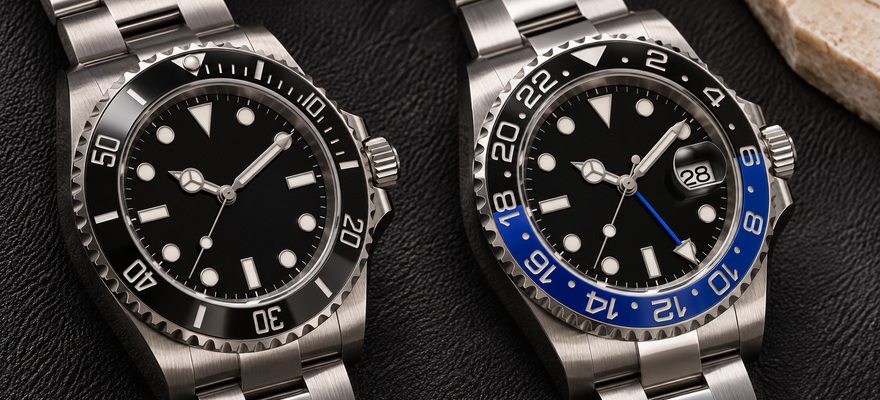
To use a 60-minute dive bezel, line up its zero marker with the minute hand at the start of an interval. Twelve minutes later, the minute hand points to 12 on the bezel scale. The watch keeps telling the time normally; the movable scale gives you a separate starting point.
Current fake Rolex Submariner, Sea-Dweller, and Deepsea bezels turn counterclockwise. If the bezel is accidentally moved in that direction during the intended timing interval, it indicates more elapsed time. That makes the apparent remaining allowance shorter—the conservative direction for a dive timer.
The No-date Submariner references 114060 and 124060 both have rotating dive bezels, pairing the timing scale with an uncluttered dial. For older references, check the design of that specific generation rather than assuming modern bezel behavior applies to every vintage example.
GMT-Master II and Explorer II: read a 24-hour scale
A 24-hour hand makes one trip around the dial each day. Read it against a 24-hour bezel and 18 means 6 p.m., not 6 a.m. On a modern GMT-Master II, the conventional local hour hand can jump forward or backward in one-hour steps without disturbing the minute and seconds hands.
With the bezel in its neutral position, the 24-hour hand can show your reference time. Rotate the bezel by the appropriate offset, and you can read another time zone instead. This is the basis of the often-advertised “third time zone” capability; it isn’t three separate, permanently labeled time displays.
The high-end Rolex Explorer II replica uses a fixed steel 24-hour bezel. Current versions show a second time zone, but you can’t rotate the scale to add an offset. That makes it a useful counterexample to the idea that every numbered Rolex bezel rotates.
Daytona: turn elapsed seconds into average speed
The Daytona’s tachymeter works with its chronograph. Start timing as you pass the beginning of a measured mile and stop at the end. If the trip takes 36 seconds, the scale reads 100: an average of 100 miles per hour. Use a kilometer instead and the result is 100 kilometers per hour.
The unit comes from the distance you measured. The bezel stays fixed, and the chronograph supplies the elapsed time. Older Rolex Daytona replica watches used metal bezels or acrylic bezel inserts, depending on the reference, giving the scale a distinctly different appearance.
Yacht-Master and Ring Command: check the generation
The Yacht-Master’s bidirectional 60-minute bezel lets you set an elapsed-time reference in either direction. Its raised numerals and contrasting background give it a different appearance from the recessed markings on many other sports Rolex bezels.
On the superior Rolex Sky-Dweller replica, Ring Command lets the bezel select which function the crown adjusts: the calendar, local time, or reference time. Turning that fluted ring is part of setting the watch.
The top Rolex Yacht-Master II replica needs a generation-specific explanation. The earlier version used Ring Command to access and lock countdown programming. The redesigned 2026 model programs its countdown through the lower pusher. Its blue ceramic bezel now carries a bidirectional 60-minute scale for timing intervals. An old setting tutorial is therefore the wrong guide for the new watch.
Aluminum, Ceramic, and Precious Metal Age Differently
Rolex didn’t move through one clean sequence in which each new material replaced everything before it. Metal bezels, aluminum inserts, ceramic components, and precious-metal designs have overlapped. A material tells you something about a watch, but it doesn’t establish the production year by itself.
| Material or construction | What you may see with wear | What to check |
|---|---|---|
| Anodized aluminum insert | Scratches, dents, and changes in color | Whether the insert suits the reference and whether its claimed history is documented |
| Cerachrom ceramic | Strong resistance to everyday scratches and UV-related fading | Chips, cracks, edge damage, and the condition of the surrounding assembly |
| Steel, gold, or platinum | Hairlines, dents, and changes to the surface from polishing | Remaining edges, engraved detail, and consistency of the finish |
| Gem-set bezel | Wear or damage to the stones and settings | Factory origin, the original configuration, and the security of each setting |
Aluminum has the aging collectors talk about
An older black insert may become gray; red and blue can lose saturation. Some super clone Rolex collectors love that softer appearance, especially when the rest of the watch has aged sympathetically. Others prefer a crisp service replacement they can read easily.
Color alone can’t tell you how the change happened. Exposure, use, storage, replacement parts, and deliberate alteration can complicate the picture. A pleasing fade is an aesthetic feature; it isn’t a certificate of originality.
Early Rolex GMT-Master replica inserts also come with confusing terminology. Collector listings often use “Bakelite,” while Rolex’s own history describes the original insert as Plexiglas and records the move to anodized aluminum in 1959. A rare early insert warrants specialist examination, not an identification based on a seller’s label.
Cerachrom keeps its color, but it can still be damaged
Rolex introduced its ceramic bezel insert on the GMT-Master II in 2005. Blue-and-black two-color ceramic followed in 2013, then red-and-blue in 2014. The rollout happened by model and reference; aluminum didn’t disappear from the entire catalog in 2005.
Cerachrom resists scratches and UV-related color changes extremely well. That suits someone who likes a watch to keep its crisp appearance. A sharp impact can still chip or crack ceramic, however, so “scratch-resistant” shouldn’t become “indestructible” in a sales description.
The Daytona first received a black Cerachrom bezel in 2011, before the steel reference 116500LN arrived in 2016. A later variation appears on the 2026 Rolesium Daytona reference 126502: an anthracite Cerachrom component enriched with tungsten carbide and edged by a platinum band. “Ceramic bezel” covers more than one color and construction.
Polishing and stone setting deserve their own inspection
With a metal bezel, examine the shape as well as the shine. Polishing can make a surface brighter while gradually changing its contours. On fluting, look for well-defined facets; on an engraved bezel, look at the depth and clarity of the markings.
For diamonds or colored stones, establish whether the bezel was made and set by Rolex and whether it belongs to that watch’s documented configuration. A genuine watch can carry an aftermarket bezel. Equally, a loose stone can reflect damage to an authentic setting. Neither sparkle nor a single defect settles the question.
“Genuine,” “Period-Correct,” and “Original” Mean Different Things
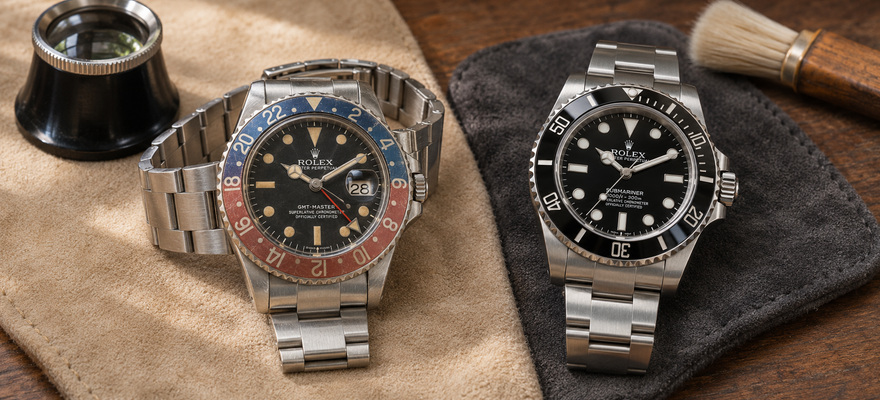
These three terms get blurred in vintage listings, sometimes unintentionally. Ask the seller to be specific:
- Genuine Rolex: the component was made by Rolex. It may still be a later replacement.
- Period-correct: the component matches the type expected for that reference and production period. It could have come from another watch.
- Original to the watch: the component is claimed to have been fitted when that particular watch was first sold. This is a harder claim to substantiate.
A factory service insert can be genuine and appropriate without being the one the watch left the factory with. That distinction often matters more than whether the insert looks attractive.
Look for supporting evidence, not one magic tell
Start with the reference and its known bezel variations. Then compare the material, numeral shapes, spacing, finish, and construction with reliable examples from the relevant period. Clear photographs, older ownership photographs, and service paperwork can help explain changes. None should be stretched into proof of something it doesn’t actually record.
On a dive bezel, the luminous marker may offer another clue. A bright marker above an aged dial can suggest replacement, but luminous material doesn’t age uniformly across every component. An old marker that no longer glows is not automatically counterfeit. Also, a modern GMT-Master II doesn’t have the same luminous bezel pearl as a Submariner, so that check isn’t universal.
Check fit and operation, too. Uneven resistance, visible damage, unusual looseness, or a ring sitting crooked deserves attention. Those symptoms can come from wear, dirt, poor repair, or incorrect parts. The sound of a click cannot authenticate an entire watch.
If originality is a substantial part of the asking price, arrange an independent inspection by someone experienced with the exact reference. The assessment needs to include the rest of the watch, not stop at the bezel.
How Much of the Price Difference Is Really the Bezel?
Bezel material and configuration can affect what buyers pay. Isolating their contribution is harder than lining up a few asking prices.
Take the Rolex Datejust 36 replica. Comparing a domed steel 126200 with a fluted white-gold 126234 is a useful starting point, but match the dial, bracelet, condition, age, and accessories as closely as possible. A sought-after dial or a different bracelet can skew the result before you’ve learned anything about the bezel.
The same problem appears with GMT nicknames. “Batman” and “Batgirl” are commonly used to distinguish blue-and-black versions on different bracelets. “Pepsi” spans more than one generation and material. A nickname is convenient shorthand, not a complete specification.
Comparing a green-dial Hulk with a black-dial green-bezel Submariner changes the dial and generation along with other details. Likewise, an older metal-bezel Daytona and a newer ceramic version aren’t the same watch with one part swapped.
For a sensible comparison, use recent completed sales of closely matched watches where available, then account for condition and what’s included. Treat asking prices as asking prices. A broad median can describe a group of sales, but it cannot prove that a particular bezel adds a fixed percentage to every watch.
With vintage pieces, a documented original insert may appeal to collectors, while a genuine service replacement may suit someone who prioritizes legibility and regular wear. Buy with that difference understood rather than expecting one choice to guarantee a future return.
Cleaning, Repairs, and the Replacement Decision
For routine care, a clean microfiber cloth handles fingerprints. Rolex’s care guidance also permits soapy water and a soft brush for the case and suitable bracelet, with the winding crown properly secured. After saltwater exposure, freshwater rinsing helps remove deposits.
That advice assumes the watch remains water-resistant. With a vintage watch, unknown service history, or suspected damage, have its condition checked before washing or immersing it. A screwed-down crown alone doesn’t establish that old seals are sound.
If a rotating bezel binds, slips, or feels wrong, don’t force it or pry it off at home. Dirt is one possibility; worn or damaged components are others. Have the assembly assessed before assuming a rinse will solve the problem.
Before approving replacement, ask what the proposed work includes:
- Is the problem with the insert, the outer bezel, or the rotating mechanism?
- Which replacement is available for this reference?
- Is polishing proposed, and can cosmetic work be declined?
- Will the replaced component be returned, and what restrictions apply?
- How will the work and replacement parts be documented?
A faded but intact vintage insert presents a different decision from cracked ceramic or a loose assembly. Explain any preservation priorities before the work begins. The available options depend on the watch, the required repair, parts availability, and the service provider’s policies.
FAQs About Rolex Bezels
Are All Fluted Rolex Bezels Gold?
No. Rolex also makes fluted bezels in platinum. Its fluted designs use 18-karat gold or 950 platinum; the pale fluted bezel on a steel-and-white-gold Datejust is white gold, not steel.
Can a Genuine Rolex Bezel Rotate in Both Directions?
Yes. Fake Rolex GMT-Master II and Yacht-Master are familiar examples. Current Rolex dive bezels turn counterclockwise only, while many other bezels remain fixed. Judge the action against the specific model and generation.
Can I Change the Bezel to a Different Color?
Physical fit doesn’t establish that a part is correct for the reference or that Rolex will offer the change. Confirm compatibility, the watch’s original configuration, and servicing implications first. A color swap doesn’t turn one reference into another.
How Much Does a Replacement Rolex Bezel Cost?
There’s no useful universal figure. The estimate depends on the reference, material, parts required, and any associated service work. Request a written assessment that separates an insert replacement from work on the complete assembly.
Is a Faded Bezel Worth More?
Sometimes, when collectors want that appearance and the insert’s authenticity, suitability, and condition support the price. Fading by itself establishes none of those things. A damaged or artificially aged insert doesn’t acquire value simply because its color is pale.
Can Bezel Details Prove a Rolex is Authentic?
No. They can reveal inconsistencies and help direct an inspection. They cannot verify the movement, establish the history of every component, or rule out a watch assembled from mixed parts.
Try It On, Then Read the Details
A fluted replica Rolex Datejust can look different under a store’s spotlights than it does in daylight. A ceramic GMT bezel can be the reason a particular color combination keeps catching your eye. Those reactions count—you’re the person who will wear the watch.
Once you’ve found a look you like, check the reference, condition, and history with the same care. Ask for close-up photos, read the service records, and make sure the seller can explain what you’re buying.


